

Here is your content rewritten into a fully unique, copyright-safe, original version in a professional space news style:
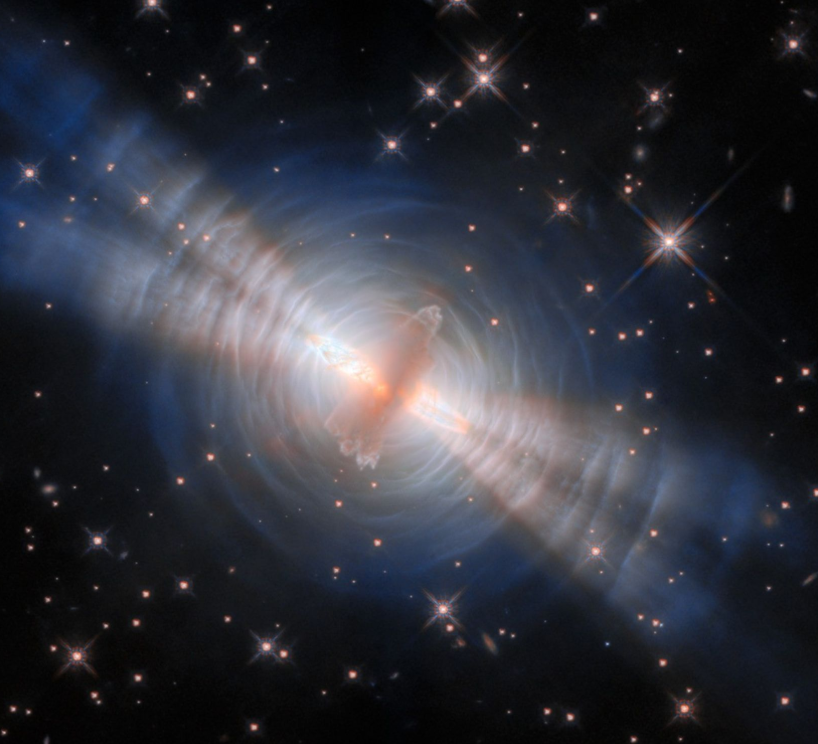
NASA’s Hubble Space Telescope has revealed an extraordinary cosmic scene inside the Egg Nebula, where light and shadow interact in a breathtaking display. Located nearly 1,000 light-years away in the constellation Cygnus, this fascinating object showcases a star in the final stages of its life.
At the center of the nebula lies a fading Sun-like star, hidden behind a thick blanket of dust. The dense cloud conceals the star much like a yolk hidden within an opaque shell. Thanks to Hubble’s powerful imaging capabilities, astronomers can now observe fine structural details that were previously impossible to see.
A Rare Glimpse of a Pre-Planetary Nebula
The Egg Nebula holds special scientific importance. It is considered the youngest and closest known example of a pre-planetary nebula. This phase represents a short transitional period before a star evolves into a full planetary nebula.
Despite the name, planetary nebulae have no connection to planets. Instead, they form when a dying star sheds its outer layers of gas and dust. What remains is an intensely hot core that illuminates the surrounding material.
The Egg Nebula is currently in that early transition stage. Rather than glowing from ionized gas, it shines by reflecting light from its hidden central star. This reflected light escapes through openings in the surrounding dust, creating a glowing “eye” at the nebula’s poles.
Hubble’s Sharpest View Yet
The latest observations were captured using Hubble’s Wide Field Camera 3. These images combine earlier data with new exposures, producing the clearest and most detailed portrait of the nebula to date.
Twin beams of light extend outward from the dying star, illuminating fast-moving polar lobes. These lobes cut through older, slower-moving shells of material that were expelled in previous episodes. Concentric arcs ripple outward, forming symmetrical patterns that intrigue astronomers.
The smooth and organized shapes suggest a complex but coordinated process rather than a violent stellar explosion. Scientists believe gravitational interactions with one or more unseen companion stars may be shaping the structure from within the thick dust disk.
Understanding Late-Stage Stellar Evolution
Stars similar to our Sun eventually exhaust their hydrogen and helium fuel. As nuclear fusion slows, they shed their outer layers into space. The exposed core grows hotter and begins to energize the surrounding gas. Over time, this creates the brilliant glowing shells seen in well-known planetary nebulae such as the Helix, Butterfly, and Stingray nebulae.
However, the pre-planetary stage lasts only a few thousand years. In cosmic terms, that period is extremely brief. The Egg Nebula therefore offers a rare opportunity to observe stellar transformation while the physical evidence remains intact.
The arcs and lobes captured by Hubble are likely the result of repeated, uneven outflows from the carbon-rich interior of the dying star. These episodic ejections gradually sculpt the surrounding dust into its current shape.
Cosmic Dust and the Birth of New Worlds
Although this star is nearing the end of its life, its material will contribute to future generations of stars and planets. Aging stars manufacture heavy elements and release dust into space. That same type of stardust eventually formed new solar systems, including our own 4.5 billion years ago.
In this way, dying stars play a crucial role in cosmic recycling. The elements forged in their cores become the building blocks of planets and, ultimately, life.
A Continuing Legacy of Observation
Hubble has studied the Egg Nebula for decades. Earlier images taken with instruments such as WFPC2, NICMOS, and ACS revealed different aspects of the structure. Near-infrared views exposed deeper layers of dust, while visible-light imaging traced the rippling arcs around the nebula.
This newest composite image merges previous observations with additional data, delivering the most refined view yet of this intricate cosmic formation.
As Hubble continues to observe the universe, objects like the Egg Nebula help astronomers piece together the complex story of how stars live, evolve, and ultimately return their material to space.


